BLOGS
Explore our blog for insights on cutting-edge technology and discover how our agency delivers top-notch services tailored to meet your needs.
PHP2Shell Vulnerability: Why Website Security Matters in 2026
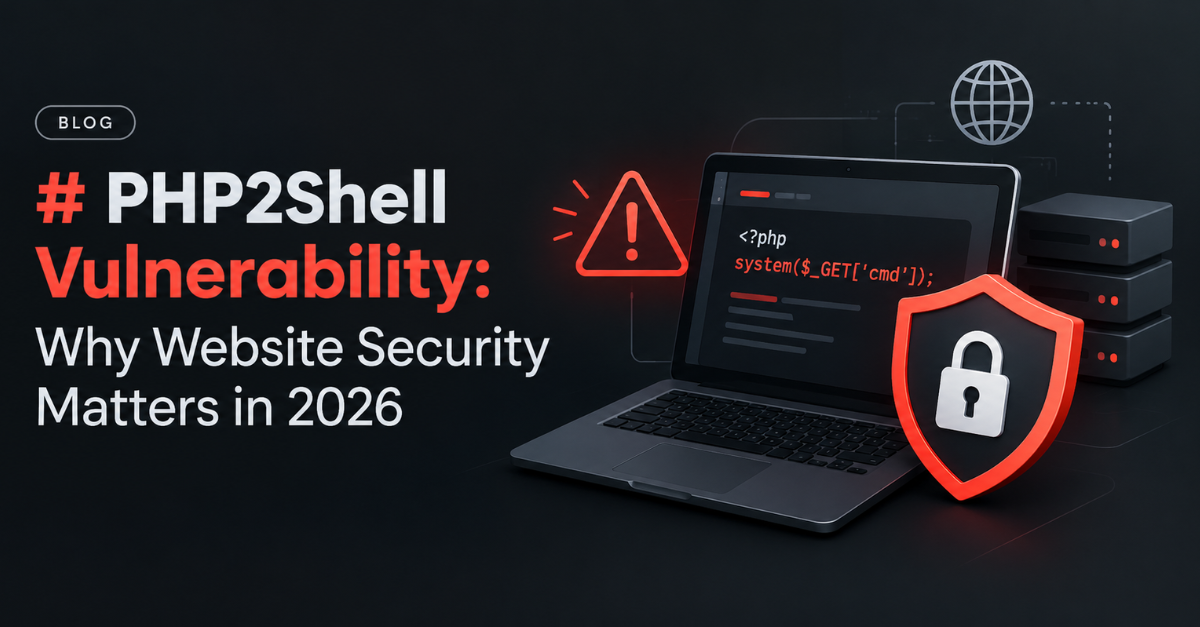
A critical security alert has put PHP-based websites under scrutiny in October 2026. Known as PHP2Shell, the issue involves two vulnerabilities in PHP itself that could allow attackers to execute malicious code remotely. For businesses that depend on their websites, this incident highlights the importance of secure development, regular updates, and choosing the right technology stack.
What Is the PHP2Shell Vulnerability?
PHP2Shell refers to two critical security flaws: CVE-2026-109618 and CVE-2026-109619. Both have a CVSS v4.0 severity score of 9.2. Under certain conditions, an unauthenticated attacker could exploit these vulnerabilities to execute code on a vulnerable server or access sensitive information from memory.
The vulnerabilities involve how PHP handles memory during errors. One concerns memory corruption following an out-of-memory condition, while the other involves references to memory that has already been released.
Because the flaws exist in the PHP runtime, updating website code or individual plugins alone will not resolve the underlying issue. Websites using vulnerable PHP versions need the appropriate security update.
Which PHP Versions Are Affected?
According to the published security guidance, affected versions include PHP releases before:
• PHP 8.5.12
• PHP 8.4.27
• PHP 8.3.36
• PHP 8.2.35
PHP 8.1 and older versions are end-of-life and require particular attention. Businesses should check their hosting environment and apply the relevant supported release or vendor-provided security fix. Updating is the primary complete remediation.
Does PHP2Shell Mean PHP Websites Are Always Unsafe?
No. This incident does not mean every PHP website is compromised or that PHP is inherently unreliable. However, it demonstrates how vulnerabilities in widely used technologies can expose businesses to serious risks when systems are not patched promptly.
Website security depends on several factors, including the software version, application architecture, server configuration, access controls, monitoring, and maintenance. Businesses should review their technology stack regularly rather than waiting for an incident to occur.
How Line Code Approaches Development
At Line Code, we build technology solutions around each project's requirements rather than depending on a single backend technology. Our development work includes Node.js, Python, and Go (Golang), selected according to application functionality, scalability needs, integrations, and long-term maintenance goals.
Node.js supports real-time applications and APIs, Python is useful for AI, machine learning, and automation, while Go can be effective for efficient backend services and concurrent workloads.
No programming language automatically guarantees security. Every technology requires secure coding, appropriate infrastructure, regular updates, and continuous monitoring.
Final Thoughts
PHP2Shell is a timely reminder that website security cannot be treated as an afterthought. Businesses should verify their PHP versions, apply relevant security updates, and investigate suspicious activity where necessary.
Planning a secure, scalable website or application? Connect with Line Code to explore technology solutions built around your business goals.